
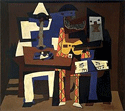
 There are dozens of ways of looking at visual art, each shaped by the creators and the various contexts in which the pieces appear. None of them are wrong, but certain methods facilitate deeper connection and understanding.
Art critics in the early twentieth century primarily concerned with formalism, including Roger Fry and Clive Bell, were largely responsible for taking foundations of compositional analysis disseminated in the seventeenth century and transforming it into the language of formal analysis that we use to describe the elements of art and principles of composition. This vocabulary helps us break down the visual components of a work and examine their effects before exploring what we think we see and what may not be immediately apparent.
Visit JSTOR Daily for complete Articles