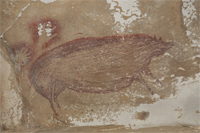
 Recently discovered cave paintings and bone carvings offer new perspectives on long-held questions about art’s origins—not to mention the nature of art itself.
But which painting, drawing, or carving deserves the superlative “oldest” is debatable. The moniker depends, in part, on how archaeologists define art itself. The Sulawesi pigs are certainly the oldest known figurative, or representational, art. That entails work depicting objects from life, Brumm explains, such that an average observer would glance at the paintings and recognize them as pigs rather than abstractions. Representational art is common in art history, from Greek Hellenistic marble goddesses to First Nations masks of killer whales and ravens in the Americas.
SDG 16: Peace, Justice, and Strong Institutions aims to promote peaceful and inclusive societies, provide access to justice for all, and build effective, accountable institutions worldwide. Read more.
And then there’s nonfigurative, or nonrepresentational, expression. Examples abound in modern art, from Mark Rothko’s color blocks on canvas to Anne Truitt’s colorful minimalist pillars. The earliest abstract markings appear hundreds of thousands of years earlier than the Sulawesi pigs, when humans and other hominids began etching parallel lines, grids, and circles into shell and bone. But archaeologists disagree as to whether these are in fact the earliest glimmers of artistic expression.
Author Amy McDermott for National Academy of Science’ News Feature Website